
Description
One plan, three kinds of user
Free AI pricing calculators take one average cost per user and one plan. Averages hide the problem: the heavy users. Undertow shows every plan at typical, heavy and extreme usage, the usage at which a user stops paying for themselves, and the price, cap or model change that fixes it — saved between visits.
Pro earns $5.22 on a typical user and loses $20.39 on a heavy one.
A request costs $0.0116 (Claude Sonnet 5.5, 10% Opus 5.5). The average across Pro users looks like a small loss; the heavy users are where the money goes.
Every plan, every kind of user
Up to four plans × typical, heavy and extreme users: margin and profit per user, the margin across all users, and the requests per month at which a user starts costing more than they pay. Coloured against your target margin, with a one-line verdict on top.
| Plan | Typical user | Heavy user | Extreme user | All users | Loses money above |
|---|---|---|---|---|---|
| Freecapped at 50 requests | −$0.4740 req · cost | −$0.5850 req · cost | −$0.5850 req · cost | −$0.49per free user | free plan |
| Pro$12.00/mo · no limit | 43%$5.22 · 300 req | −170%−$20.39 · 2,500 req | −509%−$61.12 · 6,000 req | −16%−$1.94 per user | 748requests / month |
| Team$30.00/seat · 2,000 incl., then $1.50/100 | 64%$19.20 · 600 req | 13%$5.84 · 3,000 req | 17%$20.47 · 8,000 req | 47%$17.26 per user | neveroverage covers it |
Three ways out, each with its number
For each paid plan, worked out for a heavy user: the price that reaches your target (and the price to break even), the monthly cap that holds it at today’s price and which users would hit it, and the share of requests to move to a cheaper model.
Raise Team’s price
a month per seat reaches 70% on a heavy Team user (from $30.00).
Cap Team’s usage
requests a month holds 70% at today’s $30 — all three groups would hit it.
Route to a cheaper model
of Claude Sonnet 5.5 requests moved to Claude Haiku 5.5 brings a heavy Team user to 70%.
Describe one request, then your plans
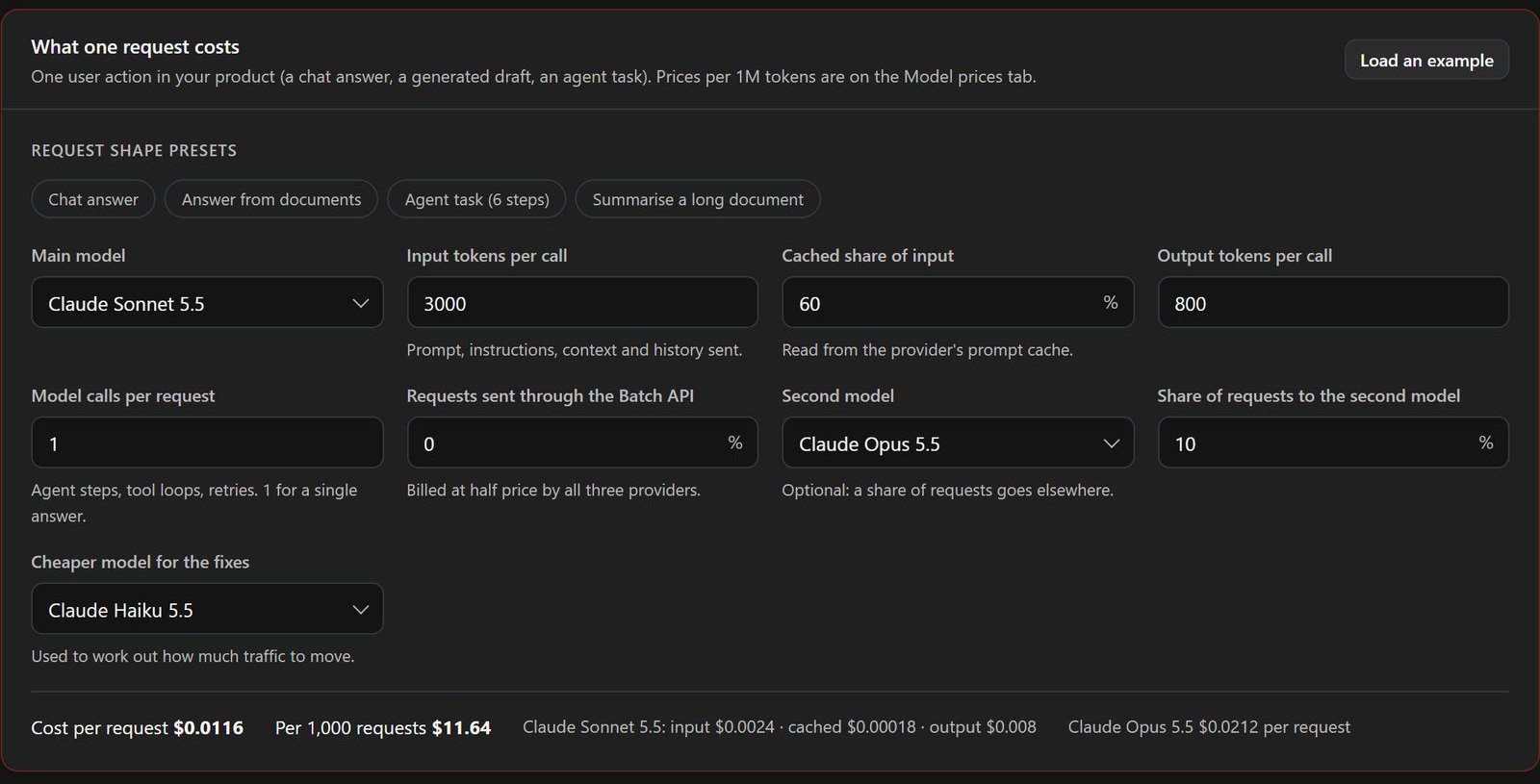
- On Setup, describe one request: the model, input and output tokens, cache share and model calls.
- Add your plans: price, usage limit, and how many requests typical, heavy and extreme users make.
- Open Margins: read each plan’s margin per user group and the usage at which users stop paying for themselves.
- Drag the levers or apply a fix — price, cap or a cheaper model — and watch every plan update.
Built for how AI plans really work
Usage limits as they really work
No limit, a hard cap, or included requests with overage billed per 100 requests. Free plans are costed too, and their model cost is shared across paying users.
Testing whether an overage price covers heavy users, or whether a free tier is eating the paid plans’ margin.
Levers and a usage chart
Drag cache share, output length, model mix, a model price change or your target margin, or edit a plan’s price or cap — every plan updates. A chart shows profit per user as usage grows, with the break-even point and each user group.
Seeing how much a better cache hit rate or shorter answers is worth before building it.
Real usage from an export
Paste user ; plan ; requests for a month: per plan, the median, 90th and 99th percentile, and the averages of the bottom 80%, next 15% and top 5% — applied to a plan in one click.
Replacing guesses with your actual heavy users once you have customers.
Dated, editable model prices
17 current text models from Anthropic, OpenAI and Google, from their official pricing pages checked on 13 October 2026, with long-prompt rates applied automatically and Google’s announced 1 January 2027 prices as a scenario. Edit any price or add your own models.
Comparing Claude Sonnet 5.5, gpt-6-sol and Gemini 3.8 Flash for the same request shape.
Your real heavy users, from one paste
| Plan | Users | Median | 90th pct. | 99th pct. | Typical avg | Heavy avg | Extreme avg |
|---|---|---|---|---|---|---|---|
| Pro | 40 | 390 | 3,200 | 8,000 | 422bottom 80% | 3,183next 15% | 7,250top 5% |
17 models, official prices, your edits
Anthropic
- Claude Fable 5.1
- Claude Opus 5.5
- Claude Sonnet 5.5
- Claude Haiku 5.5
OpenAI
- gpt-6-astra
- gpt-6.1-sol
- gpt-6-sol
- gpt-6-luna
- gpt-5.6-terra
- gpt-5.4-mini
- gpt-5-nano
- Gemini 3.8 Flash
- Gemini 3.6 Flash
- Gemini 3.1 Pro Preview
- Gemini 2.5 Pro
- Gemini 3.5 Flash-Lite
- Gemini 2.5 Flash-Lite
From each provider’s official pricing page. Not fetched live — the tool works offline — so every price is editable, and any other model can be added with its prices.
Scenario: Google’s announced prices for Gemini 3.8 and 3.6 Flash from 1 January 2027.
Where Undertow sits
Free to own, against usage-billing platforms that need a full billing stack and your live data.
| Undertow | Free AI pricing calculators | Usage-billing platforms (Orb, Metronome) | A chatbot | |
|---|---|---|---|---|
| Margin per plan at typical and heavy usage | Yes — up to 4 plans × 3 user groups | One plan, one average cost per user | Simulations on your billing history | Recomputed by hand each time |
| Break-even usage and solved fixes | Price, cap and model routing | Break-even users only | Not a planning tool | One-off answers |
| Model prices | Official, dated, editable | You enter one cost | From your real usage | From memory, often older models |
| Works before launch | Yes | Yes | Needs live data | Yes |
| Account, billing stack or data connection | None | None | Required | Account |
| Your plans and usage data | Stay on your device | — | On the platform | Sent to the service |
Questions before you add it to your dock
Does it connect to my billing or my OpenAI / Anthropic account?
No. Undertow is a planning aid that runs offline. You describe your requests and plans (or paste a usage export), and it works out the margins. Nothing is sent anywhere.
How current are the model prices?
They were checked on 13 October 2026 on the official pricing pages of Anthropic, OpenAI and Google, and the date is shown in the tool. They aren’t fetched live — the tool works offline — so every price can be edited, and you can add your own models. We re-check them and ship updates for free.
Which models are included?
17 current text models: Claude Fable 5.1, Opus 5.5, Sonnet 5.5 and Haiku 5.5; gpt-6-astra, gpt-6.1-sol, gpt-6-sol, gpt-6-luna, gpt-5.6-terra, gpt-5.4-mini and gpt-5-nano; Gemini 3.8 Flash, 3.6 Flash, 3.1 Pro Preview, 2.5 Pro, 3.5 Flash-Lite and 2.5 Flash-Lite. Any other model can be added with its prices.
My plans use credits, not requests. Does it still work?
Yes, if one credit maps to a request of a known size: enter that request shape and treat credits as requests. Included credits become the cap or the included amount, and extra credit packs the overage price per 100.
Is the result my real API bill?
No. It is as exact as the token counts you enter. Measure your average input and output tokens in your provider’s usage dashboard and use those. Cache-write surcharges, Gemini cache storage and priority-processing premiums are not included.
What do heavy and extreme users mean?
Three groups of a plan’s users, each with its requests per month and share of users — typical is most of your users, heavy your top users, extreme the very top. With real data, Undertow builds them from your bottom 80%, next 15% and top 5%.
Do I need an account? Where does my data go?
No account, no install. Undertow is a single HTML file that runs in your browser; your plans and usage data stay on your device.
Founders and small teams selling an AI-powered product on subscription plans
Pricing a launch, adding AI features to existing plans, or re-pricing after the first model bills.
- An indie founder pricing an AI writing app before launchLaunch pricing set with a fair-use cap chosen from a number, not a guess.
- A SaaS team adding AI features to existing plansThe losing plan identified, with the price, cap and model-routing options side by side.
- Choosing between modelsA routing decision backed by its effect on every plan.
- A provider announces a price changeThe impact on each plan in seconds.
Own your tools, not a subscription
Undertow is a single HTML file. Add it to your dock, use it offline, and keep it. Prices checked 13 Oct 2026.
Reviews
There are no reviews yet.